Google Ads Bidding: Everything You Need to Know!
- Manasi Rai
- May 22, 2024
- 5 min read

Tired of bidding all the time but not getting the relevant ad space? Still figuring out how ad auction works?
Well, well, you're not alone.
Starting from 2000, when self-serve advertising came into existence - people are fighting to get things right.
And if at all, one was able to hit the sweet spot - they were able to grab high-ranking visibility for a long time.
Fast forward today. Things are not the same. There's Google's automated bidding feature that has come into the picture. No more talks, let's just simply dive into it!
What is Google Ads Bidding?

In simple terms, when you bid, you show your willingness to spend a certain amount, for your ad to be shown, to your target audience.
The whole process of bidding is done through auction. Google Ads at its core is an auction based marketplace. Only the strong bids get selected. But it doesn't mean - the more you spend, the stronger your bid will become. It's not like that. Instead multiple factors are assessed.
For example,
Any advertiser, if they wish to advertise on Google - they'll first have to think WHAT'S THEIR GOAL?
Is it the clicks that matter?
Do they want more impressions?
Are they looking for a higher conversion rate?
Or, do they want more views and engagement?
Once the goal is clear, bidding gets easier. Depending on these goals, the business can further choose a bidding strategy.
Now, what are the main components of Google Ads auction?
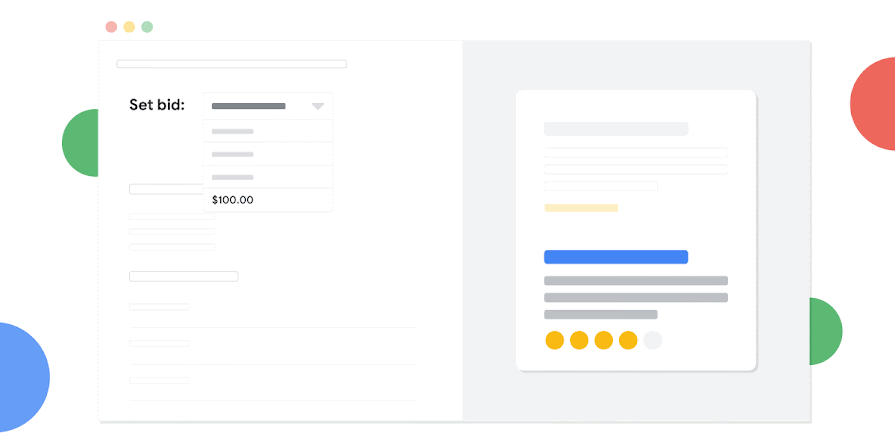
Why should your ad rank? Google over here takes three elements into account:
Bid amount - the maximum amount an advertiser is willing to pay per click
Your quality score - the quality of your ads matter. Your ad must be relevant to the search. It must include the right keywords. The landing page should align to the ad. In addition to all these, if also your CTR is strong, the quality score of your ad increases.
Ad relevance - In addition to what ad you have done above, if you have created multiple variations of the ad, it will work in your favour. Try offering copy variations, or instead create extensions that help users get more clear information.
All of these above factors can also impact the spendings. If your quality score is high, your cost per click will lower down. If the score is low, the cost will increase, and you may have to struggle more to get good ad positions.
Google Ad Auction Process
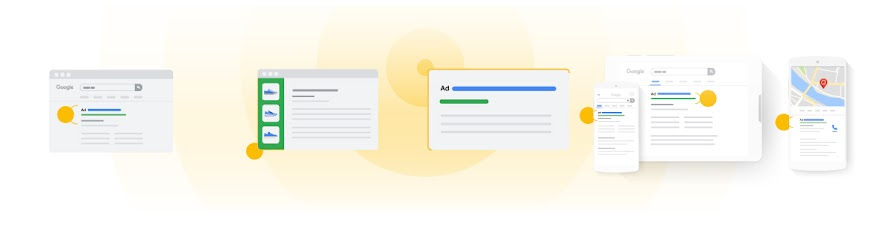
Now we know how Google assesses ads. Let's talk about what happens behind the curtain.
When a search is initiated, Google's system processes the ads with keywords relevant to the query. All the relevant ads then enter the auction. Google then calculates the Ad Rank for each ad.
Ad Rank = Bid amount × Quality Score
The ads with the highest ad Rank are then eligible to appear on the Search Engine Results Page.
What are the ad auction steps?
Query Input - Where a user types a search query
Ad Eligibility - Where Google identifies all ads with keywords that are matching the query
Ad Rank Calculation - Google calculates ad rank for each ad (eligible ones)
Ad placement - Ads with the highest ad rank are placed in the top ad slots on the SERP
What about CPC?
The actual CPC of any ad is determined by the ad rank they have got. Here's the formula that's used to ensure that you only pay what's necessary to outrank the competition
What are the different bid strategies?
So, coming to the real picture. Google Ads offer several bidding strategies. As mentioned previously, you can choose any one strategy that could help you achieve your campaign's success, like:
If you want customers to take a action instantly, you should opt for smart bidding
If you want more traffic on your website, you should consider CPC bidding
If you just want to increase brand awareness, vCPM can be the right bidding strategy
If you are into video ads and want more interactions, go for either CPV (cost per view) or CPM (cost per thousand impressions)
If you want to increase product or brand consideration, go for cost per view bidding strategy.
Let's understand each bidding strategy in detail below:
Conversions with Smart Bidding
If your sole focus is on conversion, smart bidding will be of your great help. Over here, there are multiple automated bid strategies being used by Google AI. The optimisation is done on various factors like - location, time of day, language, and operating system.
This is also called auction-time bidding.
The 5 smart bidding strategies are:
Target cost per action - Can be used to increase conversions while targeting a specific cost per action
Target return on ad spend - Can be used to increase conversions value while targeting a specific return on ad spend
Maximise conversions - Can be used for optimising conversions for the entire budget and not just a target CPA
Maximise conversion value - Can be used for optimising conversions for the entire budget and not just a target ROAS
Enhanced cost per click - If someone wants to manually adjust their bids to maximise conversions, they can go with ECPC
Getting more clicks through CPC bidding

If you're more focused towards generating more traffic on your website, you can go with CPC bidding, and the two strategies here are:
Maximise clicks - It is the simplest, automated bidding strategy for clicks. You simply have to set an average daily budget, then hope will manage your ad system to bring you the most clicks
Manual CPC bidding - Over here you can manage most of your CPC bids yourself. This strategy allows you to set different bids for different ad groups, keywords, or placements
If your core focus is on visibility, you should try these bidding strategies:
Target impression share - Even this bidding strategy is all automated. The goal is here to show your ad on the absolute top of the page.
CPM - Over here you will be paying based on the number of times your ads are shown to the viewer.
tCPM - Here, the advertiser sets an average for how much they are willing to pay for every thousand impressions. Advertiser's can change their average CPM often
vCPM - This again is a manual bidding strategy. If you don't want clicks, but want to increase awareness of a certain product or your brand, this is the best bidding strategy. You simply set the highest amount for each 1000 impressions.
To the last, if your focus is on views (if you run video ads), go for CPV bidding. With this bidding strategy you will have to pay for interactions, views, cards, and banners.
Can you adjust your bids?

Yes. You can do bid adjustments based on several factors. The popular ones are location, audience targeting criteria, times of the day when the ad is shown.
All in all, one must remember that it's the search query that triggers the auction process. The whole process happens in just the wink of an eye. Within seconds your ads will either rank to the top, or maybe never see the SERP. The above is a list of bidding strategies, you have to choose just the right one.
And fret not if you picked the wrong one. Because you can always change things up.